
Notice Archive
LANDFILL SITE CLOSED UNTIL FURTHER NOTICE

George Municipality advises residents and waste disposal operators that the landfill site is closed until further notice.
The landfill has reached capacity following breakdowns of the bulldozer. Repairs are being attended to as a matter of urgency. However, due to the current conditions at the site, it is no longer safe for members of the public and vehicles.
The Municipality sincerely apologises for the inconvenience and appreciates the public’s patience and understanding.
A further communication will be issued once the landfill site is safe to reopen.
Public Notice to Businesses: Submission of organic waste management plans
George Municipality calls on businesses in the hospitality, food manufacturing and food processing sectors to submit Integrated Refuse Management (IRM) Plans for review and approval by December 2026.
The Western Cape Government’s targets require 50% of organic waste to be diverted from landfill and 100% diversion to be achieved by December 2027.
In terms of the George Municipality Integrated Waste Management By-law (2024), the Municipality may require waste generators to submit plans outlining how they will minimise and recover waste.
What must the plan include?
The IRM Plan must set out:
- The quantity of waste generated.
- Measures to reduce waste generation and prevent pollution.
- Targets and methods for waste reduction, reuse, recycling and recovery.
- Alternative treatment, recycling or recovery options to divert organic waste from landfill.
- Opportunities to reduce waste through changes to packaging and production processes.
- Implementation timeframes, monitoring and reporting methods.
- Planned measures to phase out organic waste disposal to landfill from 1 January 2028
Businesses are encouraged to explore available organic waste processing solutions and engage with the Organic Recycling Association of South Africa (ORASA) for information on service providers and alternatives to landfill disposal.
Click here for the Public Notice to all organic waste generators to submit an integrated refuse management plan: https://www.george.gov.za/wp-content/uploads/2026/10/NOTICE-TO-ALL-ORGANIC-WASTE-GENERATORS-TO-SUBMIT-AN-INTEGRATED-REFUSE-MANAGEMENT-IRM-PLAN-RECTIFIED-1.pdf
Click here for the Extra George Waste Management By Law: https://www.george.gov.za/wp-content/uploads/2026/10/No-11-8897-Extra-George-Waste-Management-By-Law-002.pdf
Submission of plans
Completed IRM Plans must be submitted to:
Yolanda Mali
Email: ymali@george.gov.za
Enquiries
For further information, contact:
Sivuyile Mtila
Waste Management Officer
Tel: 044 802 2900
Email: smtila@george.gov.za
Businesses are encouraged to consult the George Municipality Integrated Waste Management By-law (2024) for further guidance.
General invitation: Indigent Drive
The George Municipality invites all residents to participate in the Indigent Drive, which will take place from 14 to 29 October 2026.
The purpose of the drive is to assist residents with all indigent-related enquiries and help with completing indigent applications.
Please refer to the attached schedule for the dates, times, and venues.
Residents are requested to bring all relevant supporting documents.
We look forward to assisting you.
Openbare kennisgewing: Algemene uitnodiging: Deernisveldtog
Uitgereik deur George Munisipaliteit 14 October 2026
Die George Munisipaliteit nooi alle inwoners uit om deel te neem aan die Deernisveldtog, wat vanaf 14 tot 29 Oktober 2026 sal plaasvind.
Die veldtog is daarop gemik om inwoners met deernisverwante navrae by te staan en hulp te verleen met die voltooiing van deernisaansoeke.
Raadpleeg asseblief die aangehegte skedule vir die datums, tye en lokale.
Inwoners word versoek om al hul relevante stawende dokumente saam te bring.
Ons sien daarna uit om u te help.
PLEASE MAKE USE OF OUR OFFICIAL CHANNELS FOR COMPLAINTS
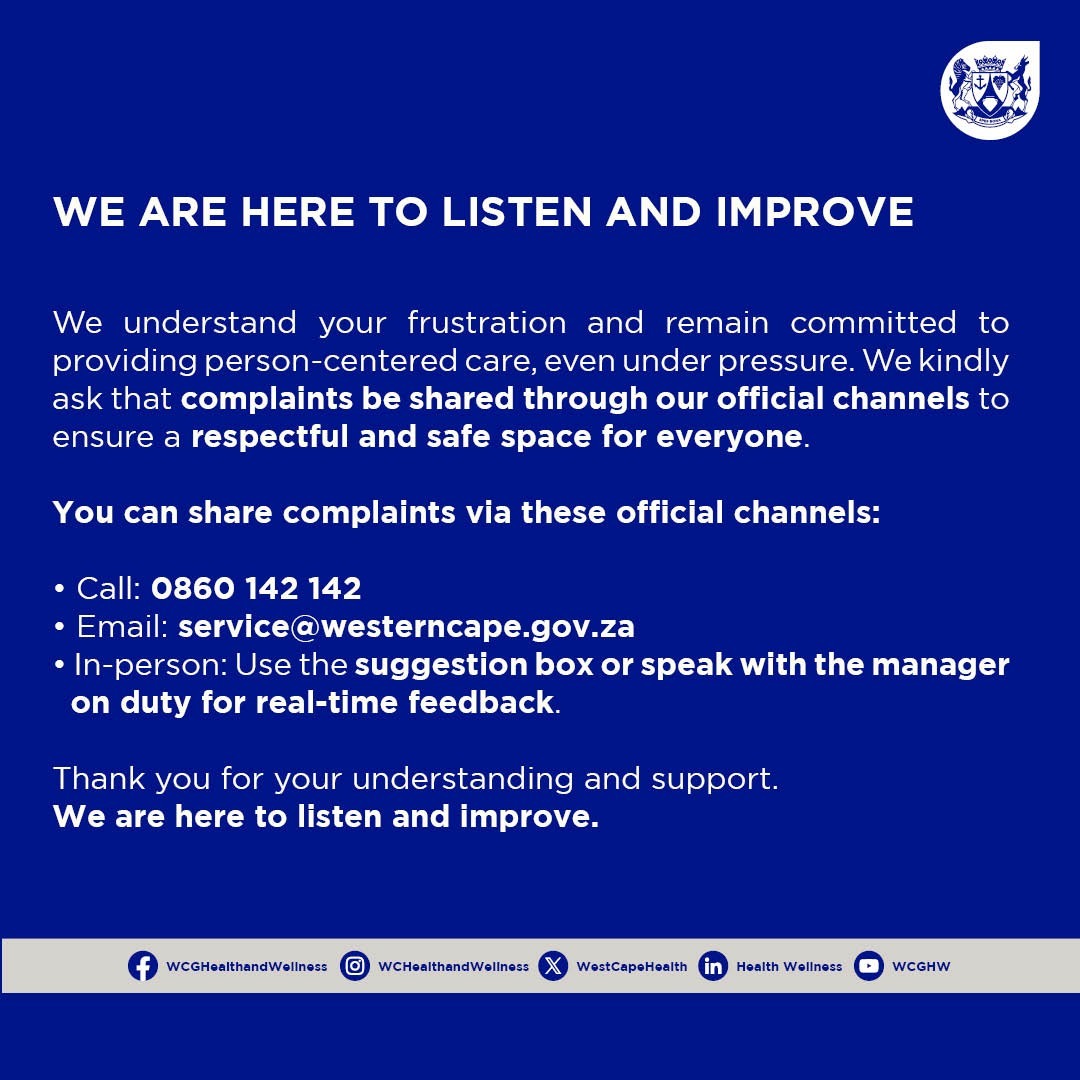
By using one of these options, you can be sure that your feedback reaches us and will be actioned.
You can share your feedback with us.
Talk to the manager on duty for real-time information.
Write your feedback down and put it in the specially marked boxes, or email it to Georgehospital.feedback@westerncape.gov.za
Maybe something comes to mind after your visit.
You can call 0860 142 142.